When temperatures drop and the likelihood of wind, rain, and snow increases, so does the risk of power outages. This is when your backup power solution needs to truly shine, springing into action to maintain business continuity and prevent costly downtime.
To ensure optimal reliability when you need it most, every backup power generator should be covered by a scheduled servicing agreement carried out by our trained engineers. However, you can also perform several essential winter maintenance checks yourself between service visits to protect against freezing conditions and ensure your backup power solution remains ready to perform.
Many of these checks form part of standard weekly inspections, but harsh winters and extreme weather conditions make them especially important.
1. Canopy and Doors – Protecting Your Generator from Winter Damage
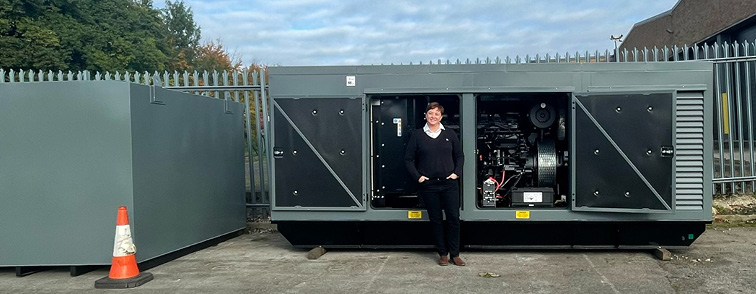
Often overlooked, the physical protection of your generator set can be critical during colder, harsher weather. Inspect the canopy for corrosion and ensure all doors and locks operate smoothly.
Winter brings increased moisture, rain, and snow, along with frequent use of de-icing salt — all of which accelerate corrosion on metal surfaces. If the canopy becomes compromised, water ingress can quickly damage sensitive internal components.
Freezing moisture can also cause locks and hinges to seize. If doors cannot be secured, the generator becomes exposed to the elements and vulnerable to tampering or part theft.
👉 Not sure what you’re seeing? Our engineers are happy to advise.
Action Tip: Clean minor rust spots and apply an anti-corrosion primer. Use a graphite lubricant on locks and hinges before the first deep frost.
2. Battery Health & Charger – Preventing Cold Start Failures
When the mains power supply is lost, your backup generator must start immediately. Battery failure is the most common cause of a generator failing to start in cold weather.
Low temperatures reduce cranking power and the battery’s ability to hold a charge. If sufficient current cannot be delivered, the generator simply won’t start when it’s needed most.
Using the generator controller, check the battery voltage. A healthy 12V battery should read ~12.6V or higher. Readings below 12.4V warrant investigation.
Battery condition also provides insight into charger health. Standby generators rely on a trickle charger to keep batteries topped up. If the charger fails, gradual discharge is almost guaranteed.
Action Tip: Inspect terminals and cables for corrosion or dirt. Clean with a stiff brush and baking soda solution, then apply protective terminal grease.
A working charger should show 13.2–13.6V on a 12V system. Lower readings or charger alarms indicate the battery isn’t receiving adequate support.
Engineer Insight: In cold conditions, batteries often pass visual inspection but fail under load. A battery that appears acceptable at rest can still collapse during cranking, particularly after prolonged standby. This is why winter failures often occur without prior warning.
👉 Concerned about battery or charger performance?Contact our team to investigate before winter outages occur.
3. Coolant & Engine Oil Checks for Winter Generator Maintenance
Correct fluid levels and antifreeze concentration are your primary defence against catastrophic engine damage during freezing conditions.
Coolant & Antifreeze – Preventing Freeze Damage
Coolant prevents overheating, while antifreeze stops the liquid from freezing. If the antifreeze concentration is too weak, the coolant can freeze, expand, and crack components such as:
Engine block
Radiator
Hoses
Action Tip: Never top up with plain water. It dilutes antifreeze and dramatically raises the freezing point while introducing impurities into the coolant system.
So, why does this matter? Freeze-related engine damage typically isn’t immediately obvious. Cracks can worsen over repeated start attempts, leading to progressive coolant loss and eventual engine failure — often during a live outage.
These failures are far more costly than routine maintenance.
Check that the expansion tank level sits between the minimum and maximum markings. Persistently low levels may indicate a leak and should be investigated.
Test the antifreeze concentration using a hydrometer or refractometer. A 50:50 or 60:40 mix is standard and vital for winter protection. Antifreeze also raises the boiling point and provides corrosion protection.
Antifreeze contains corrosion inhibitors that protect the engine’s internal metal components; however, these additives degrade over time. We recommend that coolant be replaced every 3 years — this can be included as part of our Shenton Group maintenance contracts.
Engine Oil and Winter Cold Start Stress
Most generators require specific oil grades such as 10W-30 or 15W-40. Lower “W” numbers improve the cold-weather flow.
Cold temperatures thicken engine oil, increasing resistance during start-up. Old, degraded, or low oil significantly increases the risk of cold-start failure.
Check the dipstick level and oil condition. Sludgy, milky, or gritty oil indicates contamination and requires replacement. Standby generators should receive annual minor and major services, including oil and filter changes.
Action Tip: If you notice oil leaks, burnt smells or abnormal consumption, contact our engineers early — small issues escalate quickly in winter.
Partially filled tanks allow condensation to form as moist air cools inside the tank. Water collects at the bottom, leading to:
Corrosion
Microbial growth
Freezing fuel lines
Restricted fuel flow
Keeping tanks well-filled reduces moisture formation. Long-stored diesel should be conditioned or polished — fuel polishing is a service provided by our engineers.
Inspect hoses for cracking or leaks. Diesel can also thicken in cold weather, causing:
Sluggish running
Delayed pick-up
Low fuel pressure alarms
Filter restriction warnings
👉 If symptoms appear, contact us to inspect filters and fuel condition.
SCR / AdBlue in Winter–Preventing Freezing and System Faults
AdBlue freezes at approximately –11°C.
If frozen:
❌ Do not add water
❌ Do not apply direct heat
✅ Allow it to thaw naturally
Some systems include heated tanks or lines — check controller readings and breakers. After thawing, wipe away crystallised deposits.
Action Tip: Avoid filling tanks completely as AdBlue can expand by ~7% when frozen, which can cause damage.
A standby-ready engine should feel slightly warm on safe external areas.
Signs of heater issues include:
Slow cranking
Laboured starts
Low oil pressure warnings
Cold engine after long standby
👉 If heaters aren’t operating correctly, contact our team to investigate.
5. Controls, AUTO Mode & ATS – Ensuring Your Generator Responds During Outages
After your generator has spent countless hours in idle standby, control system readiness is equally as important as mechanical checks and is central to standby generator winter preparation.
Why AUTO Mode is Critical in Winter
Ensure the Generator Controller is set to AUTO — not OFF or MANUAL. AUTO enables the controller to detect a mains failure and start the engine autonomously.
Alarms and Warnings That Prevent Load Acceptance
Check for active alarms. Even seemingly “minor” warnings can prevent load acceptance and cause unexpected ATS switching problems.
Remote Monitoring – 24/7 Visibility Without Being On Site
During winter, generators often fail when no one is present to spot early warning signs. Remote monitoring provides real-time visibility of generator status, alarms and performance.
Parameters such as battery voltage, heater operation, fuel levels, controller status, and active faults can be monitored remotely — providing reassurance during storms, overnight, or holiday periods.
For critical or unmanned sites, remote monitoring enables faster engineer response and proactive intervention, significantly reducing downtime risk.
If your set includes an ATS or a changeover panel, you should ensure:
ATS is set to AUTO
No active faults found
If it’s isolated or in manual, the generator may start, but it won’t actually power your building.
Output Breaker & Emergency Stop Check
Confirm:
Output breaker closed
All E-Stops reset
Winter clothing and equipment can accidentally activate E-Stops, especially if they’re on plant-room walls or near doors.
Action Tip: After any maintenance or testing, perform a 30-second readiness sweep to prevent costly generator downtime – controller in AUTO, no alarms, ATS in AUTO, E-Stops reset, and breaker in the correct position.
Final Thoughts – Stay One Step Ahead This Winter
Winter places additional strain on standby power systems, and outages often occur when conditions are at their worst. While professional servicing is essential, these winter checks are critical to ensuring reliable performance.
By addressing small issues early, you significantly reduce the risk of no-start scenarios, emergency callouts, and costly downtime.
From routine servicing and winter health checks to fuel management, heater inspections and emergency response cover, our team is here to help.
👉 Contact our team today to arrange a winter inspection or discuss a tailored maintenance contract.
For added peace of mind, our remote monitoring solutions provide continuous oversight of your critical power systems, enabling early fault detection and faster response — particularly valuable during severe winter weather and out-of-hours periods.
For information on HV & LV Switchgear, UPS and CHP maintenance support services, please visit these dedicated pages.
Winter Generator FAQs
Cold weather reduces battery cranking power, thickens engine oil, and can expose issues with coolant and sump heaters. Diesel can also thicken, restricting fuel flow. A quick weekly test run helps surface problems early and prevents no-start scenarios.
Typically 50:50 or 60:40 (antifreeze to distilled water). This protects against freezing, raises the boiling point, and adds corrosion inhibitors. Test with a hydrometer or refractometer and never top up with plain water.
AdBlue freezes at around –11°C. Don’t add water or apply direct heat. Let it thaw naturally — most systems resume dosing once it returns above freezing. If faults persist, check for heater alarms or tripped breakers.
Carry out a weekly offload test run (around 10 minutes) to confirm a prompt cold start and check for warnings. If you use AMF/on load testing, keep monthly tests on schedule — especially where life safety systems are involved.
Keep the tank well-filled to reduce condensation, inspect hoses for leaks or cracking, and watch for sluggish running, delayed pick up, low fuel pressure or filter restriction alarms during test runs. For long-stored fuel, consider conditioning/polishing.
Confirm controller in AUTO, no active alarms, ATS in AUTO, output breaker closed, E Stops reset, visible coolant and sump heaters operating (engine slightly warm), healthy battery voltage (≈13.2-13.6V with charger), and no signs of water ingress or corrosion on the canopy.
Shenton Group has expanded its Andover headquarters, investing in facilities, leadership, technical excellence, and future talent to support ambitious growth plans and enhance services for customers across the UK.
After nearly a decade with Shenton Group, QSHE Manager Dickie Staff reflects on the people, the culture, and the achievements that defined his career, and what he’s looking forward to in retirement.
Shenton Group teams from across the UK came together at St Mary’s Stadium to reflect on a successful year, recognise long‑service milestones, and share plans for 2026.
Don’t risk a no‑start in freezing conditions. Follow our winter maintenance checklist to safeguard backup power, minimise downtime, and keep your generator primed for rapid response.
Discover why generator hire for hospitals and care homes is essential for patient safety. Learn how Shenton Group protects healthcare with emergency power solutions.
Why is Power Resilience more important than ever? A recent power outage near Heathrow Airport has sparked conversations about critical infrastructure. Read more…
ATS panels or automatic transfer switch panels are used in combination with standby generators to automate the switch between the mains power sources and a generator in an outage or blackout.
Automatic mains failure (AMF) panels, often referred to as automatic transfer switch (ATS) panels play an important part in switching the mains power over to generators, but what exactly are they?
Is your power system still reliable?
How to spot the warning signs before it’s too late.
In this expert guide, discover:
The key indicators your system may be failing.
Why regular assessments are vital for uptime and compliance.
How consolidating your service providers can boost reliability and reduce costs.
Exciting news from our Projects team! Tarryn’s journey with Shenton Group has reached a new milestone—discover how her dedication and expertise led to this well-deserved promotion.
To provide the best experiences, we use technologies like cookies to store and/or access device information. Consenting to these technologies will allow us to process data such as browsing behavior or unique IDs on this site. Not consenting or withdrawing consent, may adversely affect certain features and functions.
Functional
Always active
The technical storage or access is strictly necessary for the legitimate purpose of enabling the use of a specific service explicitly requested by the subscriber or user, or for the sole purpose of carrying out the transmission of a communication over an electronic communications network.
Preferences
The technical storage or access is necessary for the legitimate purpose of storing preferences that are not requested by the subscriber or user.
Statistics
The technical storage or access that is used exclusively for statistical purposes.The technical storage or access that is used exclusively for anonymous statistical purposes. Without a subpoena, voluntary compliance on the part of your Internet Service Provider, or additional records from a third party, information stored or retrieved for this purpose alone cannot usually be used to identify you.
Marketing
The technical storage or access is required to create user profiles to send advertising, or to track the user on a website or across several websites for similar marketing purposes.